Etymology
The word violin comes from Italian violino, meaning “little viola,” derived from viola (a larger string instrument) plus the diminutive suffix -ino.
Pronunciation
Standard British and American English: IPA [ˌvaɪəˈlɪn], with primary stress on the second syllable (li-). In Hong Kong English, it may be [ˌvaɪ.oʊˈlin] or [ˌwaʊˈlin]. It rhymes with words like “siren” or “chagrin.”
Meaning
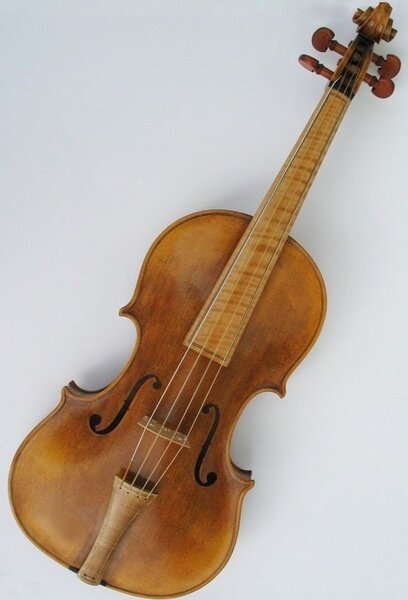
Noun: A violin is a small, wooden string instrument with four strings tuned G-D-A-E (lowest to highest). It is held under the chin and played with a bow, common in classical, folk, and various music genres.
Extended uses: Sometimes refers to the violin family (including viola and cello) or, metonymically, to a violinist in an ensemble.
Verb (rare): To play something as if on a violin, e.g., “violining the strings of emotion.”
Morphology and Grammar Notes
As a noun, violin is countable: singular “violin,” plural “violins.” No irregular forms. The verb is regular: violins, violining, violined. It’s uncountable in abstract senses, like “the sound of violin.”
Short Interesting Facts
The violin evolved in 16th-century Italy, with masters like Antonio Stradivari crafting instruments still prized today—worth millions! The term “fiddle” is often interchangeable, but “violin” sounds more formal.
Cultural or Contextual Features
In classical music, the violin leads orchestras (e.g., Vivaldi’s concertos). In folk traditions, it’s a “fiddle” for energetic dances like Irish jigs. Culturally, it symbolizes romance or melancholy, as in films like The Red Violin.
Tips on How to Learn It Easier
- Associate it with visuals: Imagine a musician tucking it under their chin.
- Use mnemonics: “Vio” like “viola” but smaller, “lin” like a fine line of strings.
- Listen to pieces like “Twinkle, Twinkle, Little Star” on violin to hear the sound.
- Practice spelling: Vio-lin, not “vio-line.”
Synonyms, Antonyms, and Common Word Combinations
Synonyms: Fiddle (informal, especially in folk music), kit violin (small historical type).
Antonyms: None direct; contrast with brass instruments like trumpet.
Common combinations: Electric violin, play the violin, violin section (in orchestra), Stradivarius violin.
Example Sentences
- Simple: She plays the violin well.
- Medium: The orchestra’s violin solo captivated the audience during the concert.
- Complex: Although he had only practiced for a year, the young musician’s violin performance, infused with passion and precision, earned a standing ovation from the seasoned critics.
Mini-Tasks for the Student
- Make a sentence: Write one using “violin” in a folk music context.
- Find a synonym: List two ways to refer to a violin informally.
- Listen and describe: Play a violin piece online and note three emotions it evokes.
- Etymology quiz: Explain why “violin” means “little viola.”