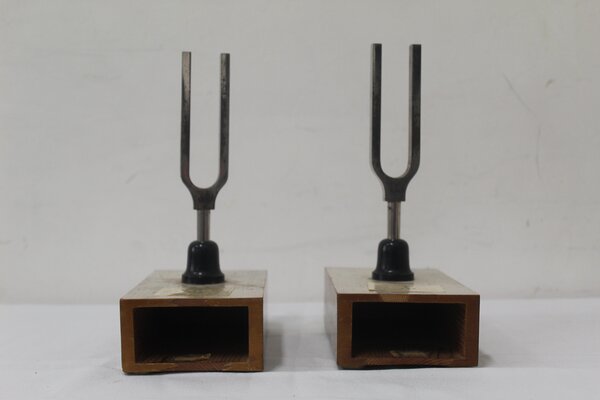
English Word: Tuning Fork
Pronunciation: In General American English, it’s pronounced as /ˈtuː.nɪŋ ˌfɔːrk/, with primary stress on the first syllable of “tuning” and secondary on “fork.” The IPA captures the diphthong in “tuning” as /uː/ and the open vowel in “fork” as /ɔːrk/. For British English, it’s similar: /ˈtjuː.nɪŋ fɔːk/, with a slight /j/ glide after /t/. Listen to audio samples online to hear the clear, resonant tone it mimics.
Meaning: A tuning fork is a small, two-pronged metal device that produces a pure musical tone of a fixed pitch when struck. It’s primarily used in music to provide a standard reference pitch for tuning instruments, ensuring they are in harmony.
Morphology: This is a compound noun formed by combining “tuning” (the gerund form of the verb “tune,” meaning to adjust pitch) and “fork” (referring to its U-shaped prongs, resembling a fork). It’s typically written as two words: “tuning fork,” though sometimes hyphenated as “tuning-fork” in older texts. No irregularities in spelling or formation.
Grammar Notes: It’s a countable noun, so use “a tuning fork” or “tuning forks” in plural. It functions as a subject, object, or modifier (e.g., “tuning fork test” in medicine). No verb forms; it’s strictly nominal.
Short Interesting Facts: Invented in 1711 by British musician John Shore, the tuning fork revolutionized music by standardizing pitch—often set to A440 Hz today. Interestingly, it’s also used in neurology to test hearing and vibration sense, like in the Weber test. Fun fact: The “devil’s tuning fork” is a slang term for a marijuana pipe due to its forked shape!
Tips to Learn It Easier: Visualize an orchestra conductor striking it before a performance to associate the word with harmony. Break it down: “Tuning” links to adjusting radios or guitars, and “fork” evokes the shape. Practice by humming the note it produces (usually a clear “A”) while saying the word aloud. Use mnemonics like “Tune in with a fork” to remember its purpose.
Cultural or Contextual Features: In Western classical music, the tuning fork symbolizes precision and unity—think of symphony orchestras starting with its pitch. It’s less common in modern digital tuning apps but remains iconic in education and traditional settings. Culturally, it appears in films like The Sound of Music for tuning scenes, highlighting its role in auditory arts.
Examples:
- Simple: The piano tuner used a tuning fork.
- Medium: She struck the tuning fork gently to match the violin’s string.
- Complex: Although electronic tuners are widespread now, many professional musicians still rely on a traditional tuning fork during rehearsals to ensure the ensemble’s intonation remains perfectly aligned with the concert hall’s acoustics.
Synonyms: Pitch standard, diapason fork (historical). Antonyms: None directly, but contrasts with off-pitch tools like untuned hammers. Common Word Combinations: Steel tuning fork, vibrating tuning fork, medical tuning fork, tuning fork frequency.
Mini-Tasks for Students:
- Make a sentence: Describe using a tuning fork in a music class.
- Find a synonym: Research another word for a device that sets musical pitch.
- Practice: Strike an imaginary tuning fork and say its pronunciation aloud three times.
- Explore: Look up how tuning forks are used in science experiments, like testing resonance.
This versatile tool bridges music and science, making “tuning fork” a word worth mastering for anyone interested in sound and harmony.