Etymology
The word trumpet comes from Middle English trumpet or trumpette, borrowed from Old French trompette, a diminutive of trompe meaning “horn” or “trump.” This traces back to Frankish *trumpa or *trumba, which is imitative of the instrument’s sound. It displaced the native Old English bīeme. Cognates include Old High German trumpa and Middle Dutch tromme (drum).
Pronunciation
IPA: /ˈtrʌm.pɪt/ (British and American English). Stress falls on the first syllable: TRUM-pit. It rhymes with words like “strumpet.”
Meanings
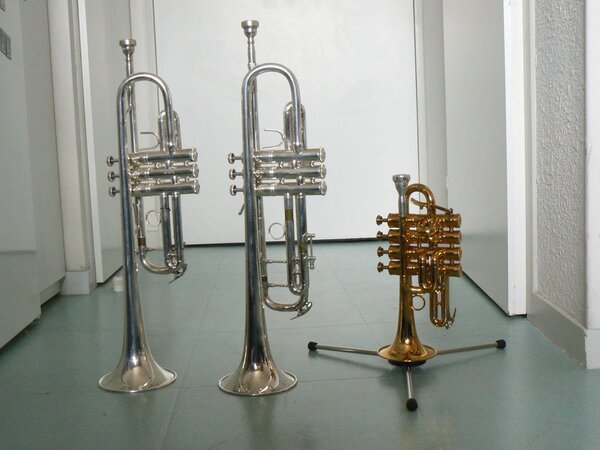
Noun: Primarily, a brass musical instrument with a flared bell, played by blowing into a mouthpiece; used in orchestras, jazz, and marching bands. Extended senses include: the cry of an elephant; a person who loudly promotes something (e.g., a propagandist); a trumpet-shaped flower (e.g., angel’s trumpet); or slang for a fervent supporter of Donald Trump.
Verb: To play the trumpet; to proclaim loudly or announce dramatically (e.g., trumpet one’s achievements); or for an animal like an elephant to make a loud call.
Morphology and Grammar
Trumpet is both a countable noun (trumpets) and a verb. Plural: trumpets. As a verb, it follows regular conjugation: trumpets, trumpeting, trumpeted. No irregular forms. Derived words include trumpeter (noun, player of the instrument) and trumpet-like (adjective).
Interesting Facts
The trumpet’s sound inspired its name, mimicking the blast of a horn. Ancient trumpets date back to 1500 BCE in Egypt, used for signaling in battles. In jazz, Louis Armstrong popularized the trumpet in the 20th century. The word also appears in idioms like “blow one’s own trumpet” (to boast).
Tips for Learning
Associate the word with its sound: imagine a loud “toot” from a brass horn. Listen to trumpet music (e.g., Miles Davis tracks) to hear pronunciation in context. Break it down: “trum” like “drum” + “pet” as in a small sound maker. Use mnemonics: “Trumpet like a trump card—bold and attention-grabbing.”
Cultural and Contextual Features
Trumpets feature in Western classical music (e.g., fanfares in Beethoven’s symphonies) and religious ceremonies like Christmas carols. In modern slang, “Trumpet” (capitalized) refers to U.S. political supporters, highlighting its evolving cultural role. Globally, similar instruments appear in African griot traditions and Indian shehnai music.
Sentence Examples
- Simple: The boy plays the trumpet.
- Medium: During the parade, the band leader blew a long note on his shiny trumpet.
- Complex: Although she had only practiced for a few months, the talented musician managed to trumpet a complex melody that captivated the entire audience at the concert hall.
Synonyms and Antonyms
Synonyms (noun): horn, bugle, cornet. (Verb): proclaim, announce, blare.
Antonyms (verb): whisper, mumble, silence.
Common Combinations: trumpet player, bass trumpet, trumpet solo, blow the trumpet, trumpet call, angel’s trumpet (plant).
Mini-Tasks
- Make a sentence: Write one using trumpet as a verb to describe promoting an idea.
- Find a synonym: List two synonyms for trumpet as a musical instrument.
- Contextual use: Describe a scene where an elephant trumpets, then translate it to your native language.
- Quiz yourself: What does blow one’s own trumpet mean? Use it in a sentence.