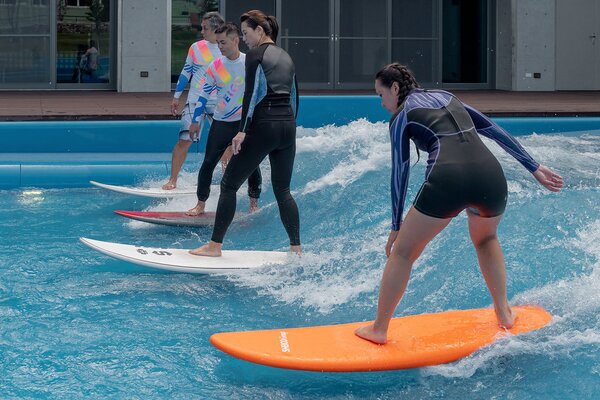
Surfing
Etymology
From the verb “surf” + “-ing,” referring to the action of riding waves or browsing.
Pronunciation
In General American English: IPA /ˈsɝfɪŋ/ (stress on the first syllable, “SUR-fing”).
It rhymes with words like “working” or “lurking.”
Meanings
As a noun (usually uncountable):
1. The sport or pastime of riding ocean waves on a surfboard.
2. The activity of browsing the internet casually.
Morphology and Grammar Notes
“Surfing” is the present participle and gerund of the verb “surf.” As a noun, it’s typically uncountable but can be pluralized as “surfings” in rare contexts (e.g., different styles). No irregular forms; follows standard English gerund rules. Use it with articles like “the surfing” for the sport or “web surfing” for online activity.
Synonyms and Antonyms
Synonyms: wave riding (for the sport), browsing (for internet use).
Antonyms: For the sport: sinking or drowning (humorous); for internet: offline work.
Common combinations: Surfing lessons, beach surfing, channel surfing (TV), couch surfing (traveling by staying with locals).
Examples
Simple: I like surfing on weekends.
Medium: After taking lessons, she became an expert at surfing big waves.
Complex: Although the ocean was rough and the wind was blowing fiercely, the experienced surfers charged into the water, eager to catch the perfect wave for an exhilarating surfing session.
Interesting Facts
Surfing originated in ancient Hawaii around 400 CE, where it was a royal sport called “he’e nalu.” Modern surfing gained global popularity in the 20th century thanks to figures like Duke Kahanamoku. The term “channel surfing” emerged in the 1980s with TV remotes, borrowing from wave surfing to mean flipping channels idly. Culturally, surfing embodies a laid-back, adventurous lifestyle, often linked to beach communities in Australia, California, and Brazil.
Cultural and Contextual Features
In English-speaking countries, surfing is iconic in places like Hawaii and Southern California, influencing fashion (e.g., board shorts) and music (surf rock). Online, “surfing the web” dates to the 1990s, evoking freedom and exploration, but now often replaced by “browsing.” Be mindful of contexts: athletic for waves, casual for digital.
Tips to Learn Easier
Associate “surfing” with visuals: Imagine riding waves or scrolling websites. Practice by watching surf videos or browsing safely online. Break it down: “Surf” (ride waves) + “ing” (ongoing action). Use mnemonics like “Surfing feels surging with energy.”
- Mini-Task 1: Make a sentence using “surfing” in the internet sense.
- Mini-Task 2: Find a synonym for “surfing” as a sport and use it in a sentence.
- Mini-Task 3: Describe a cultural aspect of surfing in your own words.
Translations (Brief)
Polish: surfing (m, inanimate).
Romanian: surfing (n, uncountable).
Spanish: surfing (m, uncountable).
Swedish: surfing (c, common gender; synonym: surfning).