“`html
Word: Lacrosse (English)
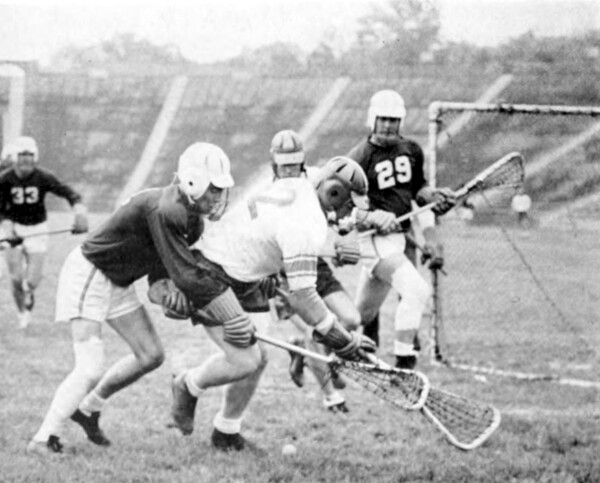
Meaning: Lacrosse is an uncountable sport played between two teams on a field. Players use sticks with nets (called crosse or lacrosse sticks) to throw, catch, and carry a ball with the objective of scoring goals by putting the ball into the opposing team’s net. It has origins in Indigenous North American cultures, was formalized in the 19th century, and is played professionally and recreationally worldwide.
Pronunciation & Stress:
- Received Pronunciation (UK): /ləˈkɹɒs/ (uh-KROSS)
- General American (US): /ləˈkɹɔs/ (uh-KROS)
- Stressed Syllable: The emphasis is on the second syllable: KROSS.
Basic Morphology:
- Word Class: Noun (uncountable)
- Origin: Borrowed directly from Canadian French “la crosse” (meaning “the stick” or “the cross”). The English word is an unadapted borrowing.
- Ending: The suffix “-se” is typical of French loanwords.
Grammar Notes:
- Lacrosse is almost always used in its singular, uncountable form in English when referring to the sport itself (e.g., “I love lacrosse,” “They play lacrosse“). You don’t typically say “a lacrosse” or “lacrosses” for the sport.
- As an uncountable noun, it uses singular verbs (“Lacrosse is fast”) and doesn’t take a singular count noun article (“a” or “an”) without specifying an instance (“a lacrosse match” or “a lacrosse stick”).
Interesting Facts:
- The name originates from the French missionaries who watched Indigenous players and named the sticks “crosse” (cross) because the netted heads resembled a bishop’s crozier.
- It’s one of the oldest team sports in North America, with roots dating back centuries in various Indigenous communities.
- Modern lacrosse features men’s, women’s, box lacrosse (indoor), and field lacrosse variations with different rules.
- It’s experiencing significant growth globally, especially in parts of Europe.
Learning Tips:
- Visual Association: Break it down: “Lac-” resembles “light,” “-rosse” rhymes with “cross.” Imagine players “KROSSing” the gap.
- Stress Practice: Emphasize the second syllable: “luh-KROSS.” Repeat quickly.
- Context Clues: Remember it’s always a sport played with sticks and a ball.
- Mnemonic: “Lacrosse is the stick (crosse) sport from Canada (la crosse).”
Short Sentences:
- Lacrosse requires good hand-eye coordination.
- We’re learning the basic rules of lacrosse.
- I watched a professional lacrosse game on TV.
Medium Sentences:
- Despite its indigenous origins, lacrosse became popular in Canadian schools during the late 19th century.
- Women’s lacrosse has several rule differences compared to the men’s version, particularly regarding physical contact.
Complex Sentences:
- Originating as a spiritual ritual and conflict-resolution tool among Indigenous nations, lacrosse, now governed internationally, recognizes the profound cultural significance embedded within its modern competitive form.
- While lacrosse has seen a surge in popularity and investment in facilities across Europe over the past decade, concerns about accessibility and the preservation of its traditional values remain significant challenges for governing bodies.
Synonyms & Antonyms:
- Synonyms: Crosse (mostly in French, sometimes understood in historical context), Field Hockey (in some regions/contexts, but different sport). The term is often unique.
- Antonyms: Not applicable, as “lacrosse” refers to a specific team sport.
Common Collocations:
- Lacrosse stick
- Lacrosse game/match
- Lacrosse team/player
- Play lacrosse
- Watch lacrosse
- Learn lacrosse
Mini-Tasks
Task 1: Synonym Search Find a synonym for “lacrosse” within this page. (Hint: It’s also a French word for “cross”)
Task 2: Sentence Creation Use the word “uncountable” in a sentence about lacrosse.
Task 3: Pronunciation Challenge Listen to the IPA pronunciation /ləˈkɹɒs/ (or /ləˈkɹɔs/) and say “lacrosse” three times, emphasizing the second syllable each time.
Task 4: Anagram Rearrange the letters in “lacrosse” to form two new words: “classerò” and “sclerosa” (found in other languages in the original text).
“