Etymology
The word “hammock” comes from Spanish hamaca, borrowed from the Taíno language spoken by indigenous peoples of the Caribbean. The Taíno term *hamaka* referred to a net-like bed. Christopher Columbus encountered it during his first voyage in 1492, describing in his journal how the natives used “hamacas” for sleeping and bartering. This etymology highlights the word’s roots in Native American culture, entering English around the early 16th century.
Pronunciation
The standard pronunciation is /ˈhæmək/ in British and American English, with primary stress on the first syllable (HAM-ək). In General Australian English, it may vary slightly to /ˈhæmək/ or /ˈhæmɪk/. Rhymes with words like “shamrock” or “barrack.”
Meaning
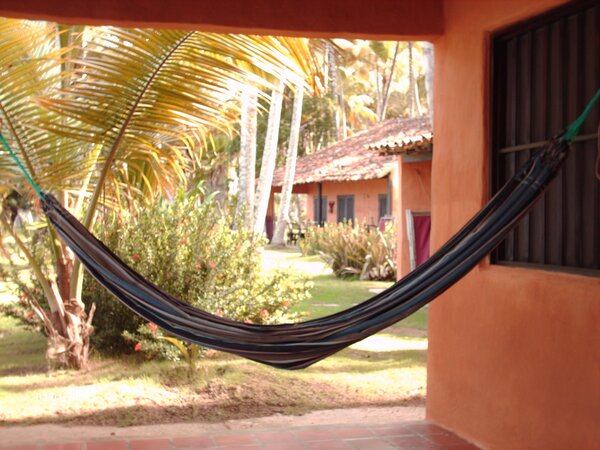
A hammock is a swinging bed or couch, typically made of netting, canvas, or fabric, suspended by cords or ropes from two points, such as trees or posts. It measures about 6 feet (1.8 meters) wide and is used for resting or sleeping outdoors. In American English dialects (archaic), it can also mean a densely wooded, vine-covered piece of land.
Morphology and Grammar Notes
“Hammock” functions primarily as a countable noun (e.g., one hammock, many hammocks). As a verb, it is intransitive (to lie in a hammock) or transitive (to suspend or wrap something hammock-like). Plural: hammocks. No irregular forms; it follows standard English inflection. Derived terms include “hammocking” (the act of using one) and loanwords like Swedish hammock, a direct borrowing from English.
Interesting Facts
Hammocks originated with the Taíno people over 1,000 years ago, providing mosquito protection and portability. Sailors adopted them in the 17th century to save space on ships and prevent seasickness. Today, they symbolize relaxation in tropical settings, from Caribbean beaches to modern gardens. Fun fact: NASA uses hammock-like sleeping systems for astronauts in zero gravity!
Cultural and Contextual Features
Culturally, hammocks evoke leisure in warm climates, often seen in Latin American, Southeast Asian, and island cultures. In the U.S., they’re popular for camping or backyard lounging. Contextually, they’re associated with vacations, but “hammocking” in TV scheduling means placing a weak show between hits to boost ratings.
Examples
- Simple: I bought a new hammock for the patio.
- Medium: Swinging gently in the hammock, she read her book under the shade of palm trees.
- Complex: While exploring the rainforest, the travelers discovered an ancient hammock woven from vines, a remnant of indigenous traditions that have influenced global outdoor living for centuries.
Synonyms, Antonyms, and Common Combinations
Synonyms: swing bed, net cot, sling bed.
Antonyms: firm bed, rigid cot (contrasting the flexible, swaying nature).
Common combinations: hanging hammock, weave a hammock, hammock chair, portable hammock stand.
Tips to Learn It Easier
Visualize a relaxing beach scene to associate “hammock” with swaying comfort—picture yourself napping in one! Break it down: “ham” like a pig’s home (cozy) + “mock” like fake rest (but real relaxation). Practice by saying it rhythmically: HAM-mock, matching the swing’s motion. Use mnemonics: “Hang A Marvelous Mock Couch” for the structure.
Mini-Tasks
- Make a sentence: Describe your ideal spot to use a hammock.
- Find a synonym: List two words similar to “hammock” and use one in a sentence.
- Explore context: Research how hammocks are used in one culture and share a fact.