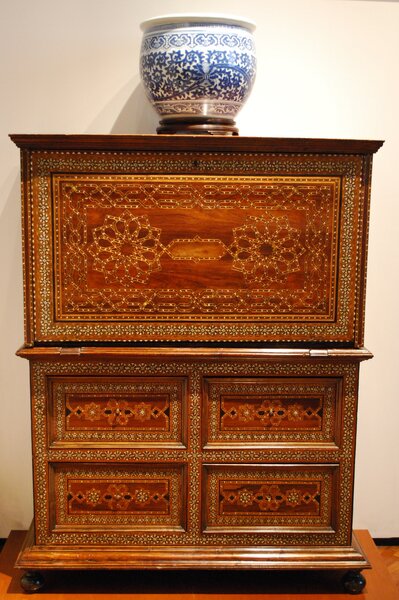
Word: Desk
Etymology
The word “desk” comes from Middle English deske or desque, borrowed from Medieval Latin desca. This was adapted from Old Italian desco, ultimately deriving from Latin discus, meaning “disc” or “quoit.” It evolved to refer to a flat surface. “Desk” is a doublet of words like “dish,” “disc,” and “disk,” sharing the same root. Interestingly, it’s related to German Tisch (“table”) through ancient Indo-European origins.
Pronunciation
In Received Pronunciation and General American English, “desk” is pronounced as /dɛsk/. The stress is on the single syllable, with a short “e” sound like in “bed,” followed by “sk.” It rhymes with words like “ask” or “task.” To practice, say it slowly: “deh-sk,” emphasizing the crisp ending.
Meanings
Noun (countable): Primarily, a desk is a piece of furniture with a flat or slightly sloped surface used for writing, reading, or working on a computer. It often includes drawers for storage. Other senses include:
- A lectern or reading table in a church, from which services are conducted (especially in the US, sometimes synonymous with a pulpit).
- A department in a business, like a news desk in a newspaper or a trading desk in finance.
- In music, a station for orchestra players, consisting of a chair and music stand; cellos often occupy the first four desks.
- Informally, short for “mixing desk” in audio production.
Verb (transitive): To furnish with a desk; to store away in a desk; or in journalism, to reject an article without full review.
Morphology and Grammar Notes
“Desk” is a simple monosyllabic noun derived from Latin roots, with no inflections beyond plural “desks.” As a verb, it conjugates regularly: desks (3rd person), desking (present participle), desked (past). It’s primarily concrete but can be abstract in business contexts (e.g., “the foreign desk”). No irregular forms; use “a desk” or “the desk” with articles.
Interesting Facts
Desks originated in ancient times as slanted writing tables in monasteries to prevent ink from spilling. The modern flat-top desk became common in the 19th century with the rise of office work. Fun fact: The world’s largest desk is over 20 feet long, built for a US president!
Tips for Learning
To remember “desk,” associate it with “discus” – imagine throwing a discus onto a flat table to write on. Visualize your own desk daily. Practice spelling by noting it’s “d-e-s-k,” not “disk” (which means something round). Use mnemonics: “Dogs Eat Salads Kindly” for the letters.
Cultural or Contextual Features
In Western culture, desks symbolize productivity and education – think school desks arranged in rows or executive desks in offices. In journalism, the “city desk” handles local news, reflecting hierarchical newsroom structures. During remote work booms like the COVID-19 era, home desks became central to daily life, blending work and personal space.
Examples
- Simple: I sit at my desk every morning.
- Medium: The teacher placed the books on the wooden desk in the classroom.
- Complex: After finishing her homework at the antique oak desk that had belonged to her grandfather, she organized her notes for the upcoming exam.
Synonyms, Antonyms, and Common Combinations
Synonyms: table (for writing), workstation, bureau.
Antonyms: floor (informal workspace), bed (rest area).
Common Combinations: Desk lamp, roll-top desk, help desk, empty desk, computer desk.
Mini-Tasks
- Make a sentence using “desk” as a verb: e.g., “The editor desked the story quickly.”
- Find a synonym for “news desk” and use it in a sentence.
- Describe your ideal desk in three words, then expand into a short paragraph.
- Research one famous desk (like Napoleon’s) and note one fact about it.