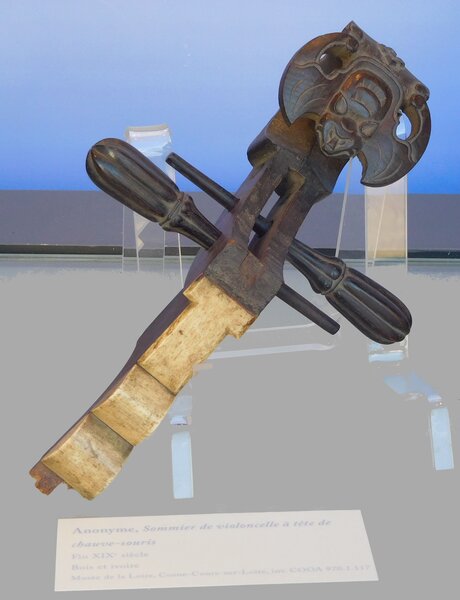
Meaning
The word cello primarily refers to a large stringed musical instrument belonging to the violin family. It has four strings tuned from lowest to highest as C-G-D-A and is typically played with a bow while seated, using an endpin for support. Less commonly, it is a shortening of “cellophane,” a transparent wrapping material, though this usage is rare and context-dependent.
Pronunciation
In Received Pronunciation (British English), it is pronounced /ˈtʃɛləʊ/ with stress on the first syllable, rhyming with “yellow.” In General American English, it is /ˈtʃɛloʊ/, similar but with a diphthong ending. The “ch” sound is like in “church,” and the vowel is a short “e” as in “bed.”
Etymology
Cello is a clipping of violoncello, from Italian violoncello meaning “little violone,” where violone is an early double bass derived from viola (violin) with the augmentative suffix -one, and diminutive -cello. It entered English in the 19th century. The cellophane sense arose as a 20th-century shortening.
Morphology and Grammar
As a noun, cello is countable, with plural forms cellos (standard) or celli (rare, from Italian). It functions as a singular or plural subject/object in sentences. No irregular forms; it’s indeclinable beyond pluralization. In musical contexts, it’s often uncountable when referring to the instrument type generally.
Interesting Facts
The cello, invented around 1550 in Italy, is known for its rich, warm tone and is a staple in orchestras, chamber music, and solos. Famous cellists like Yo-Yo Ma have elevated its popularity. Interestingly, the word’s diminutive origin belies its size—it’s larger than a viola but smaller than the double bass. In slang, “cello” once datedly appeared with an apostrophe as ‘cello.’ Globally, it’s borrowed similarly: Dutch cello, Swedish cello, and Basque cello (proscribed, prefers biolontxelo).
Learning Tips
To learn cello, associate it with its sound: mimic the deep, resonant “chel-low” by humming a low note. Visualize the instrument’s curves to remember the Italian roots. Practice spelling by noting it’s not “chelo” but starts with “c” like “violin family.” Use mnemonics: “Cell-o” as in a “cell” of music, big yet intimate.
Cultural Context
The cello symbolizes elegance in classical music, featured in Bach’s suites and Elgar’s concerto. It’s culturally versatile, appearing in folk (e.g., Irish) and modern genres like rock (Apocalyptica). In literature, as in F. Scott Fitzgerald’s life, it evokes childhood discipline or rebellion. In non-English languages, it’s often violončelo in Slavic tongues or violonchelo in Romanian, highlighting its Italian heritage.
Examples
Simple: She plays the cello every day.
Medium: The orchestra’s cellos provided a deep, melodic foundation to the symphony.
Complex: Although he had resisted his parents’ insistence on lessons during childhood, the adult musician now cherished the cello, whose somber tones mirrored the complexities of his life’s narrative.
Synonyms, Antonyms, and Combinations
Synonyms: Violoncello (formal). Antonyms: None directly; contrasts with smaller violin or larger double bass. Common combinations: Cello bow, cello case, play the cello, cello solo, string quartet (with cello).
Mini-Tasks
- Make a sentence: Write one using cello in a musical context.
- Find a synonym: List two words related to string instruments.
- Pronounce and record: Say /ˈtʃɛləʊ/ aloud and compare to an online audio clip.
- Explore: Research a famous cello piece and summarize it in three sentences.