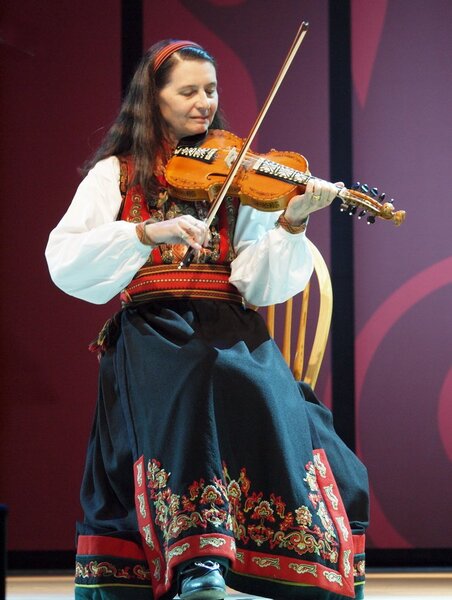
Musician Meaning: A musician is a person who creates, performs, or conducts music. This includes composers, singers, and instrumentalists who engage in music as a hobby, job, or profession. Pronunciation The word is pronounced as /mjuˈzɪʃən/ in IPA, with primary stress on the second syllable (mu-SI-cian). It rhymes with words like “physician” and “condition.” Etymology Inherited from Middle English musician or musicien, derived from Old French musicien, which combines musique (“music”) with the suffix -ien. This traces back to Latin musica, meaning “art of music.” Morphology and Grammar Notes Musician is formed by adding the suffix -ian to music, indicating a person associated with a profession or field. It is a countable noun, used in singular (“a musician”) or plural (“musicians”). No irregular forms; possessive is musician’s. Short Interesting Facts The term musician first appeared in English around the 14th century, during the rise of medieval music. An obsolete variant, musitian, was used in early texts. Interestingly, the word shares roots with “muse,” linking it to ancient Greek inspirations for the arts. Tips to Learn It Easier Break it down: music + -ian (like in physician or politician), remembering it denotes someone who practices that art. Visualize a person playing an instrument while saying the word to associate sound and meaning. Practice spelling by noting the “ci” as in “music.” Cultural or Contextual Features In Western culture, musicians like Beethoven or modern pop stars like Taylor Swift highlight the word’s evolution from classical to contemporary contexts. Globally, musicians play vital roles in traditions, such as Indian classical ragas or African griot storytelling through music, emphasizing music’s universal appeal. Sentence Examples Simple: The musician plays the piano. Medium: My friend is a skilled musician who joins the band every weekend. Complex: Although she began her career as a street musician in New York, she eventually rose to fame as a Grammy-winning artist performing worldwide. Synonyms, Antonyms, and Common Word Combinations Synonyms: performer, artist, instrumentalist, composer (slang: musicianer). Antonyms: Non-musician, layperson (in musical contexts). Common Combinations: Street musician, session musician, professional musician, lead musician, amateur musician. Mini-Tasks for Practice Make a sentence using musician in a professional context. Find a synonym for musician and use it in your own example. List three famous musicians and describe their instruments. Create a short dialogue where one person compliments another’s musical talent.
Meaning and pronunciation of the word ‘modulation’
Etymology The word modulation comes from Late Middle English modulacion, borrowed from Middle French modulation and directly from Latin modulātiō, meaning “rhythmical measure” or “melody.” It derives from the verb modulor (“to measure or sing rhythmically”), rooted in modulus (“small measure”), ultimately from Proto-Indo-European *med- (“to measure”). By surface analysis, it’s modulate + -ion, indicating a process or action. Pronunciation In Received Pronunciation (British English): /ˌmɒdʒʊˈleɪʃən/, with stress on the third syllable (mod-u-LA-tion). In General American (US English): /ˌmɑːdʒəˈleɪʃən/, similarly stressed on the third syllable. Rhymes with words like “calculation” or “revelation.” Morphology and Grammar Notes Modulation is a noun formed by adding the suffix -ion to modulate, which follows the pattern of verbs ending in -ate (e.g., regulate + -ion = regulation). It functions as both countable (e.g., “several modulations”) and uncountable (e.g., “modulation in music”), with no gender or case changes in English. Plural: modulations. Meanings General: The act of modifying or adjusting something to achieve balance or proportion. Music: Variation in pitch, tone, or key; a smooth shift from one key to another. Electronics/Physics: Encoding a signal onto a carrier wave, as in radio transmission (e.g., amplitude modulation). Biology: Changes in cell activity due to environmental factors. Art/Typography: Variation in intensity, form, or stroke thickness. Short Interesting Facts In music history, modulation creates emotional tension, famously used by composers like Beethoven to surprise listeners. In telecommunications, invented in the early 20th century, it enables radio broadcasting—without it, FM radio wouldn’t exist. The term links ancient Roman ideas of measured harmony to modern signal processing. Tips on How to Learn It Easier Associate modulation with “modifying” music or waves—think of DJs “modulating” beats or tuning a radio dial. Break it into mod (mode/measure) + u (you adjust) + lation (like relation, a connection). Practice by describing a song’s key change: “That modulation lifted the mood.” Cultural or Contextual Features In Western classical music, modulation is a key technique for harmonic progression, symbolizing emotional shifts in pieces like symphonies. In pop culture, it’s essential for radio and TV signals; FM (frequency modulation) offers clearer sound than AM. Culturally, it reflects balance in arts, from ancient architecture’s proportional modules to modern digital audio effects. Examples of Sentences Simple: The singer used modulation to soften her voice. Medium: In radio engineering, amplitude modulation carries the audio signal over long distances. Complex: While the orchestra maintained a steady rhythm, the pianist introduced a subtle modulation from C major to G major, enhancing the piece’s dramatic climax and evoking a sense of resolution. Synonyms, Antonyms, and Common Word Combinations Synonyms: Adjustment, variation, inflection (in music/voice); encoding (in tech). Antonyms: Constancy, uniformity, stasis. Common Combinations: Frequency modulation (FM), amplitude modulation (AM), phase modulation; key modulation (music); voice modulation; signal modulation. Mini-Tasks for the Student Make a sentence using modulation in a musical context. Find a synonym for modulation related to radio and use it in a sentence. Listen to a song and identify any key modulation—describe how it affects the mood.
Meaning and pronunciation of the word ‘minuet’
English: Minuet Etymology From French menuet, diminutive of menu (“small”), from Latin minutus (“very small”). The name reflects the dance’s small, delicate steps. Pronunciation /ˌmɪn.juˈɛt/ (British and US English). Stress: Primary stress on the second syllable (min-u-ET). Rhymes with “duet.” To pronounce: Start with “min” like in “minute,” add “yoo” as in “you,” and end with “et” like “wet.” Meaning A minuet is a graceful, slow dance from 17th-century France, typically in triple time (3/4 meter). In music, it refers to a composition following this form, often found in classical suites, sonatas, or symphonies. Morphology and Grammar Notes Part of speech: Primarily a noun (countable: e.g., “several minuets”); rare verb form means “to dance a minuet” (e.g., third-person: minuets). Morphology: Borrowed from French as a noun; no irregular forms. It’s uninflected in basic use but takes plural -s for multiple dances or pieces. No gender in English. Short Interesting Facts The minuet was a staple of European courtly life in the Baroque era, symbolizing elegance and restraint. Composers like Bach, Mozart, and Beethoven wrote famous minuets; Handel’s Music for the Royal Fireworks includes one. Though rare today as a social dance, it influences modern ballroom styles and survives in classical performances. Tips to Learn It Easier Link it to “minute” (small steps, from the same root), but visualize a powdered-wig dancer for context. Practice saying it with a French accent: “mee-nyoo-EH.” Listen to a minuet on YouTube (e.g., Mozart’s) while air-dancing the steps to build association. Cultural or Contextual Features Originating in France around 1650, the minuet spread across Europe as aristocratic entertainment. Dancers moved in pairs with precise, courtly gestures—no wild jumps! In music, it’s the third movement in many symphonies, contrasting faster sections with its stately rhythm. Examples Simple sentence: The band played a lively minuet. Medium sentence: At the ball, couples gracefully performed the minuet in powdered wigs. Complex sentence: While the minuet originated as a formal dance in the courts of Louis XIV, it evolved into a sophisticated musical form that composers like Haydn used to showcase thematic development within symphonic structures. Synonyms, Antonyms, and Common Combinations Synonyms: (for dance) slow waltz, courtly dance; (for music) gavotte, sarabande (similar Baroque forms). Antonyms: None direct; opposites might include “frenetic jig” or “lively polka” for contrasting styles. Common combinations: Minuet step (dance move), minuet tune (musical piece), dance a minuet, Baroque minuet. Mini-Tasks for Practice Make a sentence: Write one using “minuet” in a historical context. Find a synonym: List two words similar to “graceful” that could describe a minuet. Recall and use: Describe a famous composer who wrote minuets, and use the word in a new sentence. Listen and note: Play a minuet audio clip and jot down three adjectives for its mood.
Meaning and pronunciation of the word ‘melody’
Etymology The word melody comes from Middle English melodie, borrowed from Old French melodie, which traces back to Latin melodia and Ancient Greek μελῳδίᾱ (melōidíā), meaning “singing or chanting.” It combines μέλος (mélos, “musical phrase”) and ᾠδή (ōidḗ, “song”). Pronunciation In Received Pronunciation and General American English, it’s pronounced /ˈmɛl.ə.di/. The primary stress falls on the first syllable: MEL-uh-dee. To practice, hum it like a tune to remember the flow. Meaning A melody is a sequence of single notes that is musically satisfying, forming the memorable part of a song or tune. It provides the main theme in music, distinct from accompaniment or rhythm. Morphology and Grammar Notes Melody is a countable noun. Singular: melody; plural: melodies. It functions as a subject, object, or complement in sentences (e.g., “The melody is catchy”). No irregular forms; it follows standard English pluralization. Synonyms and Antonyms Synonyms: tune, air, theme (for a sequence of notes). Antonyms: dissonance, cacophony (opposing harmonious sound). Common Word Combinations: main melody, haunting melody, simple melody, melody line, sing a melody. Examples in Sentences Simple: I love this melody. Medium: The melody of the piano piece stuck in my head all day. Complex: Although the lyrics were unfamiliar, the melody was so captivating that the audience sang along effortlessly during the concert. Short Interesting Facts In ancient Greece, melodies were central to theater and poetry, often accompanied by the lyre. The word’s roots highlight music’s blend of phrase and song, influencing everything from pop hits to classical symphonies like Beethoven’s Moonlight Sonata, famous for its flowing melody. Cultural or Contextual Features Melodies vary by culture: Western music emphasizes linear melodies, while Indian ragas build intricate, improvisational ones. In pop culture, “earworm” melodies, like those in Beatles songs, demonstrate how simple patterns create lasting appeal. Tips on How to Learn It Easier Associate it with a favorite song—hum the melody and say the word aloud. Break it down: “Mel” like “melancholy” music, “ody” like “ode” to song. Listen to instrumental tracks to isolate melodies from lyrics. Mini-Tasks for Practice Make a sentence: Write one using melody and a musical instrument. Find a synonym: List two synonyms and use one in a new sentence. Create a tune: Describe or hum a simple three-note melody. Explore: Listen to a song and identify its main melody—note why it’s memorable. Related terms include melodrama (dramatic storytelling with music) and harmony (simultaneous notes complementing the melody). For further study, explore musical scales, which form the building blocks of melodies.
Meaning and pronunciation of the word ‘measure’
Word: Measure Meaning: “Measure” primarily refers to a standard unit or method for determining size, amount, or extent. As a noun, it can denote a quantity, limit, or standard of judgment. As a verb, it means to determine the size, length, or amount of something using a tool or method. It also extends to concepts like moderation, musical rhythm, or legislative actions. Pronunciation The word is pronounced with primary stress on the first syllable. In Received Pronunciation (UK): /ˈmɛʒ.ə/. In General American: /ˈmɛʒ.ɚ/. Audio tip: The “zh” sound is like the “s” in “measure,” soft and buzzing. Rhymes with “treasure” or “pleasure.” Etymology From Middle English mesure, borrowed from Old French mesure, ultimately from Latin mēnsūra (“a measure”), derived from mētīrī (“to measure”). It displaced Old English metan (“to measure”). Morphology and Grammar Notes Morphology: Base form is measure. Noun: countable (e.g., “a measure”) or uncountable (e.g., “in measure”). Plural: measures. Verb: Regular conjugation—measures (present), measuring (participle), measured (past). It can function as a transitive verb (taking an object) or stative (describing state, e.g., “The room measures 10 feet”). No irregular forms. Noun Definitions and Examples A standard unit or quantity: E.g., Simple: Use a cup as a measure. Medium: The recipe calls for two measures of flour. Complex: In baking, precise measures ensure the cake rises evenly without collapsing. A limit or bound: E.g., Simple: There’s no measure to her kindness. Medium: We must stay within legal measures. In music or poetry: A bar or metrical unit. E.g., Simple: The song has four measures. Medium: Poets craft lines in iambic measure. A course of action or law: E.g., Simple: New measures protect the environment. Complex: The government introduced emergency measures to curb inflation, balancing economic growth with public welfare. Verb Definitions and Examples To determine size or amount: Synonym: gauge. E.g., Simple: Measure the table. Medium: She measured the fabric before cutting. Complex: Using a laser tool, the architect measured the building’s dimensions to ensure structural integrity. To assess or judge: E.g., Simple: Measure your success by effort. Medium: We measure progress in steps. To distribute or adjust: E.g., Simple: Measure out the sugar. Medium: He measured his words carefully. Synonyms, Antonyms, and Common Combinations Synonyms (noun): Gauge, standard, amount, portion. (Verb): Calculate, assess, quantify. Antonyms (noun): Excess, imbalance. (Verb): Guess, estimate roughly. Common Combinations: Tape measure, full measure, beyond measure, made to measure (custom-fitted), for good measure (extra), take measures (act preventively). Interesting Facts and Cultural Features Historically, “measure” ties to ancient systems like the Roman modius for grain, influencing modern metrics. In Shakespearean English, it often meant moderation, as in “Measure for Measure,” a play exploring justice and mercy. Culturally, “tailor’s measure” evokes bespoke clothing traditions in British fashion. Fun fact: The phrase “beyond measure” dates to the 14th century, implying something immeasurable like love or grief. Tips to Learn Easier Associate with actions: Visualize a ruler when thinking of the verb; picture a cup for the noun quantity. Mnemonic: “Measure” sounds like “mezher” – imagine a treasure (“zh” sound) you measure out. Practice in context: Use apps like Duolingo for measurement-themed sentences; listen to music to grasp rhythmic “measure.” Group with related words: Link to “measurement,” “measurable,” or opposites like “immeasurable.” Mini-Tasks Make a sentence: Create one using “measure” as a verb in a cooking context. Find a synonym: Replace “measure” in “Take the child’s temperature” with a synonym. Word combo: Write a short paragraph using “for good measure” and “beyond measure.” Quiz yourself: What’s the IPA for American English “measure”? Pronounce and record it.
Meaning and pronunciation of the word ‘libretto’
Etymology The word libretto comes from Italian libretto, a diminutive form of libro meaning “book,” derived from Latin liber, also meaning “book.” This reflects its origin as a small book containing the text of a musical work. Pronunciation In British English, it’s pronounced /lɪˈbɹɛt.əʊ/ with stress on the second syllable (lih-BRET-oh). In American English, it’s /lɪˈbɹɛt.oʊ/ (lih-BRET-oh). The “r” is slightly rolled in some accents, and the ending vowel is a diphthong, like “oh” in “go.” Meaning A libretto is the text of a dramatic musical work, such as an opera, oratorio, or ballet. It includes lyrics, dialogue, and stage directions. It can also refer to a small book containing this text. Morphology and Grammar Libretto is a noun, countable and uncountable in some contexts. Plural forms are librettos (English-style) or libretti (Italian-style, more common in musical contexts). It’s a loanword from Italian, so it follows English noun declension otherwise—no gender or case changes. Interesting Facts The first famous libretto was for Claudio Monteverdi’s opera L’Orfeo in 1607, marking the birth of opera. Librettists like Lorenzo da Ponte (who wrote for Mozart) were as crucial as composers. Interestingly, libretto shares roots with “library,” both from Latin for “bark” (ancient writing material). Tips for Learning Associate it with “little book” (libretto = libro + etto, diminutive). Practice by humming opera tunes while saying it—link sound to meaning. Use mnemonics: “Liberate your voice with the libretto!” Flashcards with opera images help visual learners. Cultural Context In opera culture, the libretto provides the story backbone, often adapted from literature or myths. It’s central to Italian opera traditions, influencing global theater. Modern uses include musicals like Hamilton, where the script functions similarly. In non-English languages like French or Polish, it’s borrowed directly for musical terminology. Examples Simple: The opera’s libretto was written by a famous poet. Medium: She studied the libretto carefully before attending the performance to follow the plot. Complex: Although the composer’s music was revolutionary, the libretto’s poetic dialogue, drawn from ancient Greek tragedy, elevated the entire production to timeless acclaim among critics and audiences alike. Synonyms, Antonyms, and Word Combinations Synonyms: script, book, text (for operas); booklet (general sense). Antonyms: None directly, but contrasts with “score” (music without words). Common Combinations: opera libretto, write a libretto, libretto translation, ballet libretto. Mini-Tasks Make a sentence using libretto in an opera context. Find a synonym for libretto and use it in a sentence. Research a famous librettist (e.g., librettist for The Marriage of Figaro) and note one fact. Listen to an opera excerpt online and imagine describing its libretto.
Meaning and pronunciation of the word ‘Latin’
Meaning Latin primarily refers to the ancient language of the Romans, spoken in classical times and used in the Roman Catholic Church. As an adjective, it describes anything related to ancient Rome, its people, culture, or the Latin language itself. For example, “Latin literature” refers to works by authors like Virgil. As a noun, it denotes the language (e.g., “She studies Latin”) or a person from ancient Rome, Latin America, or a Romance-speaking country. Pronunciation The standard English pronunciation is /ˈlætɪn/ (IPA), with stress on the first syllable: LAT-in. In American English, it may be [ˈlæt.n̩] with a syllabic nasal. Rhymes with “fatten.” For clarity, listen to audio resources or repeat: start with “lat” like in “latter,” then “in” like “pin.” Etymology and Morphology Derived from Middle English Latyn, from Old French latin, ultimately from Latin latīnus, meaning “of Latium” (the region around Rome). The suffix -īnus forms adjectives indicating origin. No major morphological changes in modern English; it’s invariant as an adjective (not comparable) and uncountable as the language noun, but countable for people (plural: Latins). Grammar notes: Capitalized when referring to the language or as a proper noun. Used as a modifier without articles (e.g., “Latin grammar”). Interesting Facts Latin is a dead language but influences over 60% of English words (e.g., “aqueduct” from Latin roots). It’s the root of Romance languages like Spanish, French, and Italian. Fun fact: “Latin” itself comes from Latium, home to early Roman tribes. The Latin alphabet forms the basis of the English one, with 23 letters originally. Tips for Learning Associate it with Rome’s Colosseum or phrases like e pluribus unum (“out of many, one”). Break it down: “Lat-” from Latium, “-in” like ancient kin. Practice by labeling Roman-related items in your home with the word. Use apps like Duolingo for Latin basics to build familiarity. Cultural and Contextual Features In Western culture, Latin symbolizes classical education and law (e.g., legal terms like habeas corpus). In Latin America, “Latin” highlights shared Iberian heritage and vibrant cultures from Mexico to Brazil. Contextually, it’s used in academia for inscriptions or mottos, and in Christianity for Mass until the 1960s. Examples Simple: I read Latin books. Medium: The teacher explained Latin roots in English vocabulary. Complex: Although Latin is no longer spoken daily, its profound influence on modern science, where terms like “photosynthesis” derive from it, underscores the enduring legacy of ancient Roman scholars. Synonyms, Antonyms, and Common Combinations Synonyms: Roman (for ancient aspects), Romance (for derived cultures). Antonyms: Greek (as a contrasting classical language), non-Romance (for unrelated cultures). Common combinations: Latin America, Latin language, dead Latin, Neo-Latin (Renaissance Latin), Latin quarter (artistic district). Mini-Tasks Make a sentence: Write one using “Latin” to describe a historical event. Find a synonym: List two words similar to “Latin” in the context of languages. Explore: Translate a simple English phrase (e.g., “love conquers all”) into Latin and note its cultural use.
Meaning and pronunciation of the word ‘keyboard instruments’
Meaning Keyboard instruments refer to musical instruments that are played by pressing keys on a keyboard, which typically trigger sounds through mechanical, electronic, or digital means. Common examples include the piano, organ, harpsichord, synthesizer, and accordion. This term encompasses a wide range of devices central to music performance across genres. Pronunciation The pronunciation is /ˈkiːbɔːrd ˈɪnstrəmənts/ (KEE-bawrd IN-struh-muhnts). The primary stress falls on the first syllable of each word: KEY-board IN-struh-ments. In American English, it may sound slightly like /ˈkiːbɔːrd ˈɪnstrəmənts/ with a flatter ‘o’ in “board.” Morphology This is a compound noun formed by combining “keyboard” (a noun describing the key arrangement) and “instruments” (plural of “instrument,” from Latin instrumentum, meaning tool). As a plural form, it follows standard English noun pluralization by adding “-s” to “instrument.” No irregular changes occur. Grammar Notes Keyboard instruments is a countable plural noun. It functions as a subject, object, or complement in sentences. Use articles like “the” or “some” before it (e.g., “some keyboard instruments”). It pairs with verbs like “play,” “tune,” or “perform on.” Avoid treating it as singular; say “are” instead of “is.” Short Interesting Facts Keyboard instruments date back to ancient times, with the hydraulis (a water-powered organ) invented around 3rd century BCE in Greece. The modern piano, invented in 1700 by Bartolomeo Cristofori, revolutionized music by allowing dynamic volume control. Today, digital keyboards can mimic hundreds of sounds, bridging classical and electronic music worlds. Tips on How to Learn It Easier Associate the term with familiar objects: visualize a piano or electronic keyboard at home. Break it down: “key” like computer keys, “board” like a flat surface, and “instruments” as music tools. Practice by listing examples daily. Use mnemonics like “Keys Board Instruments” to recall the compound structure. Listen to music featuring them, such as Beethoven sonatas, to reinforce auditory memory. Cultural or Contextual Features In Western classical music, keyboard instruments like the organ are staples in churches and concert halls, symbolizing grandeur. In pop and jazz, synthesizers add innovative layers. Culturally, the piano is iconic in homes worldwide, fostering self-taught musicians. In Asia, instruments like the yangqin (Chinese hammered dulcimer) blend traditional and keyboard elements, showing global adaptations. Examples Simple: She loves keyboard instruments. Medium: The music store sells many keyboard instruments, from pianos to synthesizers. Complex: While traditional keyboard instruments such as the harpsichord require precise finger technique, modern digital versions offer beginners adjustable sensitivity and built-in tutorials to ease the learning curve. Synonyms, Antonyms, and Common Word Combinations Synonyms: Keyboards (informal, often electronic), claviers (historical/French term). Antonyms: No direct opposites, but contrasts include percussion instruments (e.g., drums) or string instruments (e.g., violins) as non-keyboard categories. Common Combinations: Acoustic keyboard instruments (non-electric), electronic keyboard instruments (synthesizers), portable keyboard instruments (for travel). Mini-Tasks for the Student Make a sentence: Write one using “keyboard instruments” in a description of your favorite music genre. Find a synonym: List two synonyms and explain why they’re similar. Explore examples: Name three specific keyboard instruments and note one famous musician who plays each. Practice pronunciation: Record yourself saying the word three times, focusing on stress, then compare to an online audio source.
Meaning and pronunciation of the word ‘jazz’
Word of the Day: Jazz Meaning: ‘Jazz’ primarily refers to a genre of music originating in the early 20th century in African American communities of New Orleans, characterized by improvisation, syncopation, and blue notes. It can also mean energy or excitement (figuratively), nonsense, or, in slang, semen. As a verb, it means to play jazz music, enliven something, or complicate it. Pronunciation IPA: /dʒæz/ (stressed on the single syllable). It sounds like “jaz” with a soft ‘j’ as in ‘jam’. Rhymes with “has” or “lads”. Morphology and Grammar Notes As a noun, ‘jazz’ is usually uncountable (e.g., “I love listening to jazz”), but can be pluralized as “jazzes” in rare contexts. The verb form follows standard conjugation: jazzes (3rd person singular), jazzing (present participle), jazzed (past). No irregular forms. It’s often used attributively, like “jazz music” or “jazz club”. Etymology and Interesting Facts The origin is unknown but first appeared around 1912 in baseball slang, possibly linked to ‘jasm’ (energy). By 1915, it described music. Fun fact: Jazz influenced global culture, from swing dancing in the 1930s to modern fusion genres. It’s not just music—Louis Armstrong popularized it worldwide, symbolizing American innovation and African rhythms blended with European harmony. Cultural and Contextual Features Jazz embodies improvisation and freedom, rooted in West African traditions and blues. It’s played in clubs, festivals like Montreux Jazz Festival, and features artists like Miles Davis or Ella Fitzgerald. In slang, “all that jazz” means “and so on.” Internationally, it’s borrowed directly (e.g., French jazz, Spanish jazz) but adapted in pronunciation, like Polish /dʐɛs/. Synonyms, Antonyms, and Common Combinations Synonyms (noun): blues (music), energy, nonsense (rubbish). Antonyms: For music sense: classical (structured); for energy: boredom. Common combinations: Jazz music, free jazz, jazz up (enliven), all that jazz (etcetera). Examples Simple: I play jazz on the piano. Medium: The band performed lively jazz at the festival. Complex: Although jazz originated in New Orleans, its improvisational style has evolved globally, influencing artists who blend it with rock and electronic elements to create innovative sounds. Tips to Learn It Easier Associate ‘jazz’ with upbeat rhythms—listen to a short clip of Duke Ellington while repeating the word. Practice by describing your day: “That party had a lot of jazz!” Use mnemonics: “Jazzy energy zips around.” For non-native speakers, note the /dʒ/ sound, similar to ‘judge’. Mini-Tasks Make a sentence: Write one using ‘jazz’ as a verb to describe improving something boring. Find a synonym: List two words meaning “excitement” and use one in a jazz-related context. Explore: Search for a famous jazz musician and note how the word appears in their bio.
Meaning and pronunciation of the word ‘instrumentation’
English: Instrumentation Etymology From “instrument” + “-ation,” referring to the act of providing with instruments or using them effectively. Pronunciation IPA: /ˌɪnstrəmɛnˈteɪʃən/ Stress: The primary stress is on the third syllable (-TAY-), with secondary stress on the first (IN-struh-men-TAY-shun). It rhymes with “fascination.” Morphology Instrumentation is a noun derived from the verb “instrument” (to equip with instruments) plus the suffix “-ation,” which forms nouns indicating an action or process. Root: Latin “instrumentum” (tool or implement). Plural: instrumentations. Grammar Notes Countable and uncountable noun. Use as uncountable for general concepts (e.g., “Instrumentation is key in science”); countable for specific instances (e.g., “The instrumentation failed”). No gender; follows standard English noun agreement. Meanings The act of equipping with or using instruments, especially for measurement or control. In music, the arrangement of a composition for different instruments; also, the technique of playing instruments. In automotive contexts, the dashboard gauges and controls in a vehicle. In computing, the process of adding code to analyze a program’s performance. Synonyms Orchestration (music), equipping, setup (general); profiling (computing). Antonyms Disassembly, removal (opposite of equipping). Common Word Combinations Scientific instrumentation, musical instrumentation, instrumentation error, flight instrumentation. Examples Simple: The lab needs new instrumentation. Medium: Precise instrumentation helped measure the earthquake’s intensity. Complex: In orchestral music, the composer’s innovative instrumentation not only highlighted the violins but also integrated electronic elements for a modern twist. Short Interesting Facts The term gained prominence in the 20th century with the rise of jazz and big band music, where “instrumentation” described creative arrangements. In space exploration, NASA’s Apollo missions relied on advanced instrumentation to monitor vital systems, showcasing its role in human achievement. Cultural or Contextual Features In Western classical music, instrumentation evolved from Baroque ensembles to full symphonies, influencing composers like Mahler. In tech culture, it’s essential for debugging software, tying into the “instrument everything” philosophy in DevOps. Cross-culturally, similar concepts appear in non-English languages, like French “instrumentation” (pronounced /ɛ̃s.tʁy.mɑ̃.ta.sjɔ̃/), emphasizing musical or scientific use. Tips on How to Learn It Easier Break it down: “Instru-ment-ation” – think “in-strument-action.” Associate with everyday tools: car dashboard = instrumentation. Practice by listing instruments in a band or lab to visualize meanings. Use mnemonics like “instrumentation orchestrates tools” for music/tech links. Mini-Tasks for Students Make a sentence: Write one using “instrumentation” in a scientific context. Find a synonym: List two synonyms and use one in your own example. Explore: Research how instrumentation changed in jazz music and share a fun fact. Quiz yourself: What’s the stress syllable in “instrumentation”? Pronounce it aloud.