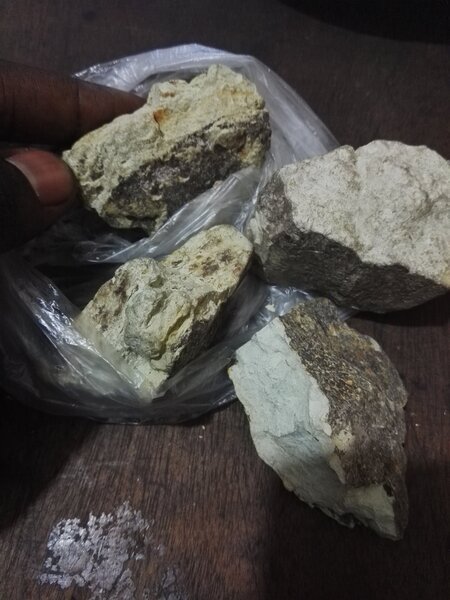
Clay
Meaning: Clay is a natural, sticky earth material composed mainly of fine particles of minerals like silica and alumina. It becomes soft and moldable when wet and hardens when fired or dried. It is commonly used in pottery, construction, and art. In broader contexts, “clay” can refer to a tennis court surface made from crushed minerals, or metaphorically, the material of the human body in biblical terms.
Pronunciation
The word “clay” is pronounced as /kleɪ/ in IPA, with stress on the single syllable. It rhymes with words like “day” or “play.” Say it by blending the “kl” consonant sound with a long “a” vowel, ending smoothly.
Etymology
From Middle English cley or clay, from Old English clǣġ (“clay”). This traces back to Proto-Germanic *klajjaz, from Proto-Indo-European *gley- (“to glue, stick together”). Cognates include Dutch klei and German Klei, reflecting its sticky nature. Related to English “glue” via Latin glūten.
Morphology and Grammar Notes
“Clay” is primarily a noun, usually uncountable (e.g., “some clay”), but countable in plural form for types (e.g., “various clays”). As a verb, it is transitive: third-person singular clays, present participle claying, past clayed. No irregular forms. It fits into noun phrases like “red clay” or verb uses in industrial contexts.
Short Interesting Facts
Clay has been used by humans for over 25,000 years, from ancient cave paintings to modern bricks. The term relates to “clog” due to its sticky quality, and in folklore, clay symbolizes the earth’s fertility. Interestingly, the smallest geological particles (under 3.9 microns) are called “clay” on the Wentworth scale.
Tips to Learn It Easier
Associate “clay” with molding playdough or pottery—feel its texture to remember the word. Visualize a “clay court” in tennis for sports contexts. Practice by linking to “glue” for its etymological stickiness. Use mnemonics: “Clay sticks like glue all day.”
Cultural or Contextual Features
In culture, clay is central to ceramics worldwide, like Japanese kyōki pottery or Native American coil pots. Biblically, God forms humans from clay (Genesis 2:7), inspiring art and literature. In modern slang, “clay” humorously means territory in geopolitical disputes, while “clay pigeon” refers to shooting targets, originating from trapshooting.
Examples in Sentences
- Simple: The child shaped the clay into a ball.
- Medium: Potters use red clay to create beautiful vases on the wheel.
- Complex: Although the clay court slowed down the tennis match, the players adapted their strategy to exploit the surface’s unique bounce, leading to an intense rally that lasted over 20 shots.
Synonyms, Antonyms, and Common Combinations
Synonyms: mud (informal), earth, loam (for soil types); for verb: coat, purify.
Antonyms: sand (opposite texture in geology); soul or spirit (biblical human body contrast).
Common Combinations: modeling clay, clay oven, baked clay, purifying clay; verb phrases like “clay up” (to cover with clay).
Mini-Tasks for Practice
- Make a sentence: Describe using clay in art.
- Find a synonym: List two words similar to “clay” in a pottery context.
- Word combo: Create a phrase with “clay” and “potter.”
- Fact recall: Why is clay linked to “glue” etymologically?